How to Re-Engage Old Real Estate Leads: The Complete 2026 Guide
A step-by-step guide to reactivating cold and dead real estate leads, with the exact text scripts, real conversations, and a system that turns a dormant database into booked appointments.
Most agents are sitting on a goldmine and treating it like a graveyard.
The leads you wrote off six, twelve, eighteen months ago (the ones who went quiet, never replied to that last email, or said “not right now”) a meaningful share of them are closer to buying or selling today than the brand-new lead you just paid $80 to acquire. They’ve already raised their hand once. They already half-recognize your name. The only thing that changed is that everyone stopped following up.
This guide walks through exactly how to re-engage those old leads: how to segment them, what to actually say (with scripts you can copy), why a simple text outperforms everything else, and how to turn a dead database back into booked appointments. At the end, you’ll see real conversations, leads more than a year cold, coming back to life from a single message.
Why your old leads are worth more than you think
Here’s the uncomfortable math behind most real estate pipelines. The industry loses the large majority of leads to poor follow-up, not poor lead quality. Internet leads from the major portals convert at low single-digit percentages at best, and the national average lead-to-close rate across online sources sits well under 2%. Agents look at those numbers, blame the leads, and go buy more, usually without ever running the head-to-head math on buying Zillow leads versus working the database they already own.
Old leads are a different proposition. Re-engaging a past contact is dramatically cheaper than acquiring a new one, because you’re not paying to reintroduce yourself: the awareness already exists. Here is what we measure on the dormant lists we have texted. About 9% of a dormant list replies. That counts every reply, including the people telling us they already sold, that it is the wrong number, or to stop. About 1 in 90 of the leads we can actually reach turns into a qualified conversation, meaning someone who replies, answers questions about what they are looking for, and gets handed to you.
Three things make an old lead valuable:
They already trust you a little. When a new lead fills out a form, five to ten agents may contact them within hours. Your old leads aren’t getting that barrage. A friendly check-in from a name they recognize faces far less resistance than a cold call from a stranger.
Their situation has changed. The buyer who couldn’t make the numbers work 18 months ago might be closing in 60 days now. Rates shifted. A lease ended. A job moved. A contract is finally winding down. You have no idea who’s ready until you ask.
You already paid for them. That acquisition cost is sunk, and working the contact again costs a fraction of what acquiring it did. (We break down the acquisition side and the cost to re-work it in what your old real estate leads actually cost you.)
The one rule that makes or breaks reactivation
Before any scripts, internalize this: lead with curiosity and value, never with a generic “just checking in.”
“Hey, just checking in!” is the single most ignored message in real estate. It asks the recipient to do all the work of remembering who you are and why they should care. It signals you want something. It gets no reply.
The messages that do get replies share a pattern: they’re low-pressure, they’re specific, and they give the lead an easy, natural way to respond, or to opt out. You’re not trying to close on the first text. You’re trying to restart a conversation. That’s the entire goal of the first touch.
Step 1: Segment before you send
Do not blast your whole database with one identical message. Segment first, even roughly. At minimum, split old leads into:
- Past clients, they’ve closed with you, they trust you most, a personal note lands hardest.
- Engaged-but-never-converted, they asked questions, toured, or replied once, then life happened. These are often the warmest.
- Original buyers vs. original sellers, their motivations and the right message differ.
- By original timeline, someone who said “maybe in a year” twelve months ago is worth prioritizing right now.
Segmenting lets you make each message feel like it was written for that person, which is the difference between an opener that gets ignored and one that gets answered.
Step 2: The opener that actually gets replies
The best reactivation opener does three things at once: it’s casual, it asks a genuine question, and it gives an explicit opt-out so it reads as respectful rather than spammy.
Here’s a proven structure, a low-pressure, “are your plans still the same?” check-in:
The status-check opener “Hey [Name], this is [Agent] with [Brokerage]. Quick question, are you still keeping an eye on the market, or has that taken a back seat for now? Reply STOP to opt out.”
Why it works: it’s a yes/no-ish question that’s easy to answer, it doesn’t assume anything about where they are, and “taken a back seat for now” gives them permission to say “yeah, paused”, which is still a reply, and still a conversation you can build on.
A second variation leads with value instead of a question, useful when you have a genuine reason to reach out:
The value/inventory opener “Hi [Name], I just came across a [property type] in [area] that lined up with what you were looking for and you came to mind. Want me to send it over?”
Either way: short, specific, opt-out included. For more openers, objection handlers, and handoff scripts you can copy, see what to text a cold real estate lead.
Step 3: Handle the objection, don’t argue with it
Most replies to a good opener aren’t “yes, let’s buy a house.” They’re soft objections, and that’s fine. The objection is the re-engagement. Your job is to acknowledge it and ask one more easy question.
Real example of how this plays out, an objection turned into a qualified lead:
Lead: “I’m still looking but the interest rate is just so horrendous right now.” Agent (via reactivation): “I hear you, the rates can be tough. Are there specific areas or price ranges you’re focusing on while you keep an eye on things?” Lead: “Love Oakland but prices there are a bit too high. Looking around 500-550.”
In three messages, a lead that had been silent for over a year just handed over their target area and their budget. That’s a qualified buyer you can now work, surfaced from a database, not bought.
Step 4: Offer something the MLS doesn’t
Stale buyers often went quiet because they got discouraged, they couldn’t find the right home on the public listings. Re-engage them by offering what they can’t easily get themselves: off-market or coming-soon inventory, or a focused search in their exact price band.
For past sellers and homeowners who went quiet, the equivalent is a localized market or equity update. Rates and prices have moved; a homeowner who wasn’t thinking about selling may be sitting on far more equity than they realize. A specific, neighborhood-level update reminds them of their position without any hard pitch.
Step 5: Hand off fast when they’re warm
When a lead signals real intent, move immediately from automated/low-pressure mode to a personal connection. The handoff text is simple:
“Hey [Name], great to hear that, [Agent] will be reaching out to you shortly.”
Speed matters here. The advantage of an old lead is that competitors don’t even know they’re back in the market yet. Don’t waste that head start by letting a warm reply sit for hours.
Why text beats email and calls for this
If you take one tactical thing from this guide: run reactivation over text, not email.
The channel data is lopsided. Email open rates hover around 20%, meaning roughly 8 of 10 of your reactivation emails are never even seen. Phone calls increasingly go to voicemail as people screen unknown numbers. Text messages, by contrast, are opened nearly universally and usually read within minutes. The overwhelming majority of home buyers now say they prefer to hear from their agent by text. For waking up a quiet database, SMS is simply where the eyes are.
A critical compliance note, though: texting works only with leads who previously opted in, people who submitted a form, attended your open house, or otherwise gave consent. Cold-texting a purchased list isn’t just ineffective, it runs afoul of regulations like the TCPA. Reactivation is powerful precisely because it targets people who already raised their hand. Always include an opt-out (the “Reply STOP” in the scripts above), and keep your outreach to your own opted-in database.
The problem with doing this manually
Everything above works. The catch is that doing it by hand doesn’t scale.
To genuinely work a database of a few thousand old leads, you’d need to segment them, write personalized openers, send them, watch for replies around the clock, handle each soft objection with the right follow-up, qualify the warm ones, and hand them off, all while running your actual transactions. Most agents start a reactivation push, get busy with live deals, and the database goes cold again within two weeks. The follow-up that was supposed to happen never does. That’s not a discipline failure; it’s a capacity problem, and the usual fix is either hiring help or automating it, a tradeoff we weigh in AI vs. a virtual assistant for lead reactivation.
This is exactly the gap automated, conversational reactivation tools are built to fill, and where Klosed comes in.
How Klosed re-engages your dead leads automatically
Klosed is built to do everything in this guide, automatically, in your voice. You upload your old leads, and Klosed texts them with the same kind of low-pressure, opt-out-included opener shown above, then qualifies the replies and hands the warm buyers and sellers back to you ready to work. No manual sending, no watching your phone, no leads going cold again because you got busy.
The conversations below are real (names and identifying details removed for privacy). Every one of these leads was more than a year cold before Klosed reached out with a single status-check text.
A revived seller, SERHANT, West Hollywood condo. A past-client relationship that had gone silent re-opened from one check-in, with the lead volunteering their exact future timeline: they’d sell the condo once a multi-year work contract wrapped. Most agents would have written that contact off entirely. Instead, the agent now knows precisely when to follow up, and stays top of mind until then.
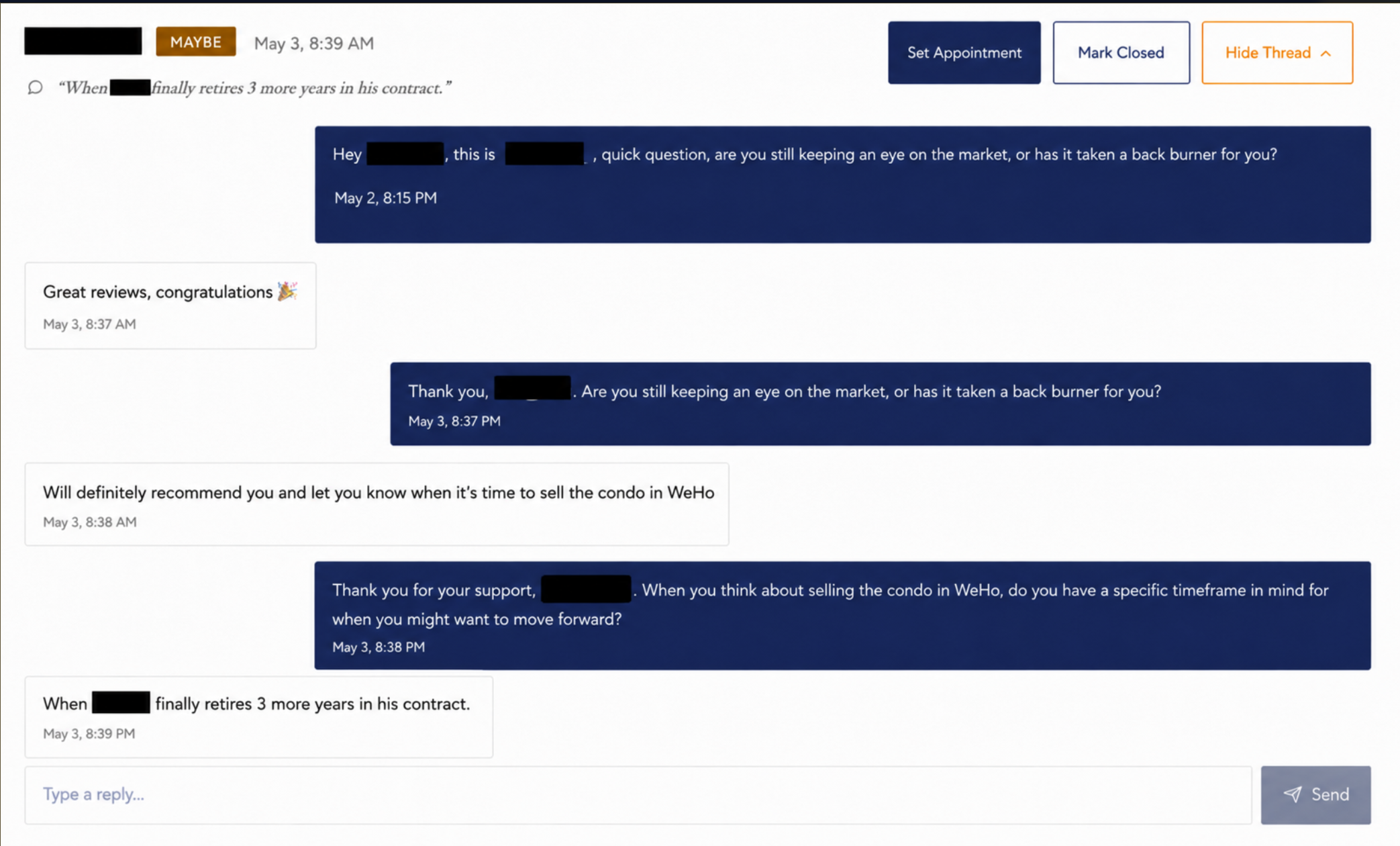 A real conversation Klosed initiated with a year-cold past client. Names blurred for privacy.
A qualified buyer, Oakland, $500-550K. The “horrendous interest rate” objection above. One acknowledging follow-up turned a year-old silent lead into a buyer who named their area and budget unprompted.
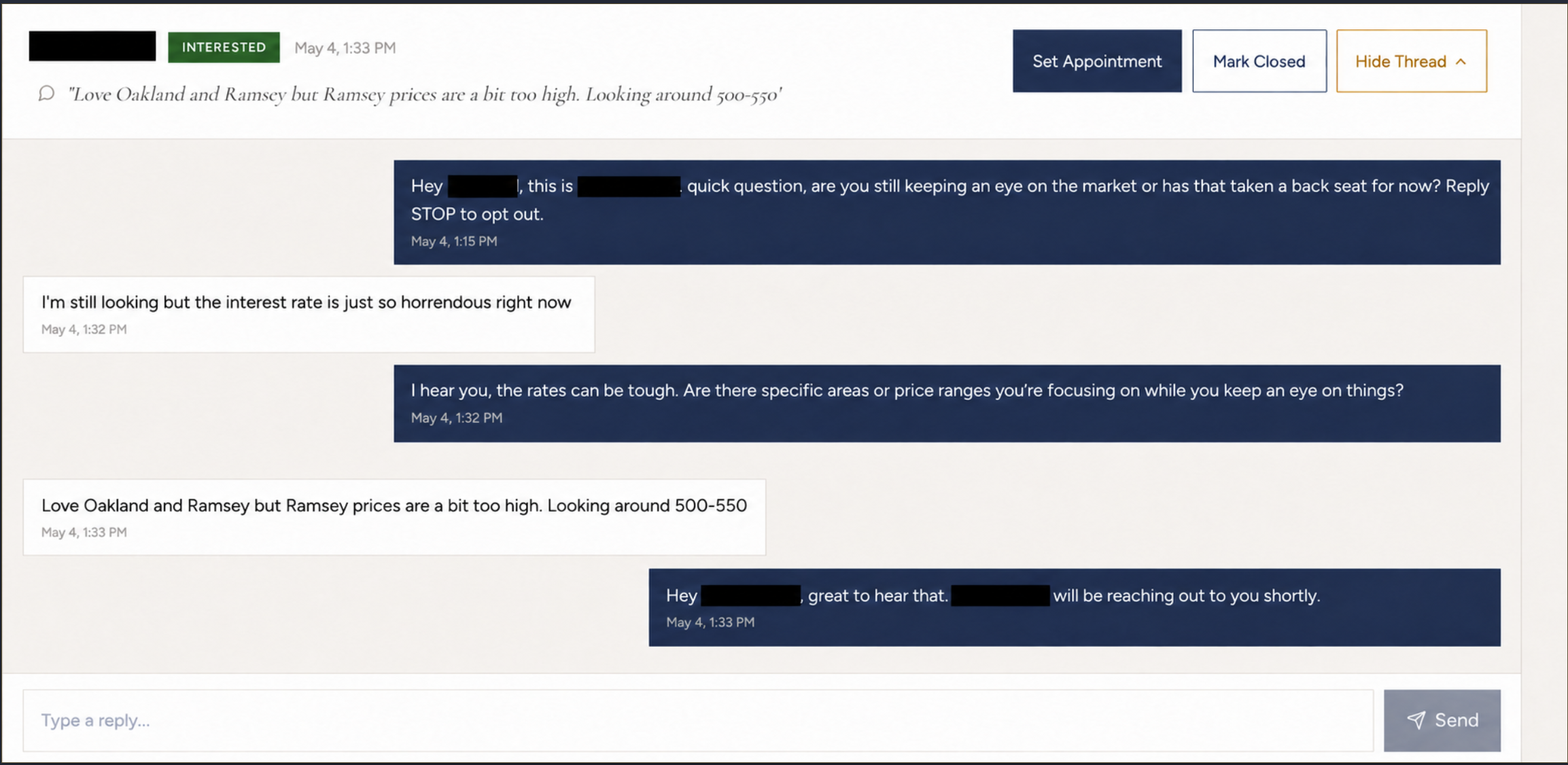 A real reactivation conversation from a year-cold buyer. Names blurred for privacy.
The same simple opener (“are you still keeping an eye on the market, or has that taken a back seat for now?”) surfaced, from leads all over a year old:
- A buyer actively shopping a multi-million-dollar property in Malibu
- Buyers ready to move within 2-3 months
- Manufactured-home buyers in the Thousand Oaks area
- Condo buyers in central Los Angeles
- The West Hollywood seller with a multi-year timeline
These aren’t new leads. They were sitting in a database, written off as dead, until one text brought them back.
Your 30-day reactivation plan
If you want to start this week, here’s a realistic cadence:
- Pull your old leads, everyone who opted in and went quiet 6+ months ago. Export them from your CRM.
- Segment into past clients, never-converted leads, and buyers vs. sellers.
- Send the status-check opener by text, with an opt-out, to one segment at a time.
- Reply to every response, acknowledge objections, ask one qualifying question, don’t pitch.
- Hand off the warm ones to a real conversation fast.
- Repeat weekly. Reactivation isn’t a one-time blast; it’s a rhythm.
For a day-by-day version of this cadence (with the exact sends, segments, and reply-handling system mapped across four weeks) see our 30-day database reactivation plan.
Do it by hand and you’ll prove to yourself the database has gold in it. Automate it with Klosed and you’ll keep mining it without it ever eating your week.
Logan Bates, Founder, Klosed